






|
Occasional Letter to Friends | Fall 2017 | the Center for Education Reform Dear Friends: It’s working. We are clearly making progress. You, we, our collective efforts. Never before have so many remarkably influential people, with literally tens of millions of supporters and followers combined, felt so compelled to utter the worst kinds of falsehoods. No, we are not talking about politics. We are talking about the Education Establishment. In this fall edition you will learn why Matt Damon teamed up with the unions to challenge the idea that money should follow children, and why his actions represent such hypocrisy. You will learn how the unions are losing power, how parents are gaining power, and about the best opportunities to succeed in states and the nation. Most of all, you’ll learn how you are making a difference, or how you could, if you’re not yet fully involved. So, grab a spiked cider and enjoy your Autumnal Occasional EdReform Letter to Friends. 
BACKPACK FULL OF HYPOCRISY and our budding relationship with Matt Damon The defenders of the status quo are feeling the heat we’re bringing to the reform movement: reaching 3,100 lawmakers, helping to assure the re-authorization of the D.C. Opportunity Scholarship Program, contributing to the creation of more than 165,000 new charter and private-school choice seats since 2016, pushing federal initiatives aimed at de-regulating charters, promoting innovation, achieving funding equity and more. We also remain education reform’s strongest, most persistent advocate for creating opportunities, empowering parents, promoting their rights, and disrupting the status quo. This has left the education establishment feeling threatened and led them to undertake a scorched-earth strategy of insult, insinuation, and misinformation to try to stop us. At the top of the list of these misleading endeavors is BACKPACK FULL OF CASH, a documentary produced by the groups Stone Lantern Films, Inc. and Turnstone Productions, Inc. and narrated by Matt Damon. It paints our cause for educational opportunity as a one-sided, selfish money-grab by capitalist evil-doers bent on destroying public education. Of course, it fully ignores the fact that the education reform community is made up of an incredibly diverse array of individuals from across the nation, with strong commitments to kids, parents and communities. But then that would lend honesty and accuracy to the film and undo its effectiveness as anti-reform propaganda. The film is something that required an aggressive response, especially given that its title is an out-of-context quote of yours truly! It’s all become something of a media saga. Hollywood Reporter, October 4th “In the trailer, Jeanne Allen of the Center for Education Reform is seen using her metaphor along with a cartoon visual of a student with dollar bills flying from his backpack.” Exclusive: Allen Pushes Back Against Matt Damon | 2024.edreform.com The Boston Globe, October 5th USA Today, October 5th “As to the narrator, Matt Damon, the A-list actor who has become a fierce defender of public schools, agreed to fill that role. Allen has criticized him as well for speaking out against publicly funded but often privately-run charter schools, while sending his kids to private schools.” EdWeek, October 12th New Matt Damon Movie Maligns Poor Parents | 2024.edreform.com
#EDUCATEMATTDAMON. Never content to let the great work of millions of people over the past 25 years be tarnished, CER has now launched a social media campaign offering real lessons that might help the Hollywood star realize that he’s on the wrong side of the issue, and has been duped by people whose interests are more about preserving power than helping families and kids. This campaign includes telling success stories in print and through video (using clips from among our 250 charter school success stories that were a result of our campaign to challenge another ignorant celebrity, John Oliver). We will also take the campaign to Philadelphia, where people who were born in and lead the city of Brotherly Love will tell a different story than what the opponents of education opportunity say through their documentary, their blogs and their rhetoric. Thanks to State Senator Anthony Hardy Williams, Boys Latin Founder & CER Board member David Hardy, Philly Parent Power leader Sylvia Simms and others, we will show the public what really happened to kids at the hands of unions, and how charter schools restored justice to thousands. What’s next? The controversy will linger as long as the film is out there (it’s being shopped around for screenings in several cities) and as long as it is, we’ll speak out against it and hope you will as well. As I wrote in the Huffington Post: “It’s hard to believe anyone really considers giving parents the power to control their kids’ education to be controversial. Many across the ideological spectrum are maligned daily by those whose power is lost when parents gain [and] when filmmakers create a false narrative in an attempt to bolster failing schools – and don’t acknowledge that the unions were probably their biggest funding source – it’s despicable.”  N.B., The response to that piece was a screed from none other than Diane Ravitch, who was once a proponent of education choice, but has since developed close associations with and support for teachers unions. Painting our cause as right wing is laughable, but it just shows how baseless the opposition is. Where we sit, the decline of union power is rapid and inevitable. 
WHILE HYPOCRISY IS WAXING, UNION POWER IS WANING The Backpack film is just one instance of recent efforts to stem union loss of influence with the public and with legislators by attacking education reform.
 We also spoke out loud and clear against her odious assertions in the Wall Street Journal (‘Randi Weingarten’s Racial Demagoguery’ ) and in the National Review(‘Randi Weingarten’s History Lesson: School Choice Helps the Poor’). Read these and more at www.2024.edreform.com/randi
And, to come full circle, there is the little matter of AFT’s funding of the Matt Damon propaganda piece and its support for the film’s screenings across the country. They really are Paper Tigers. We’ve documented the decline of union influence frequently over the years, most recently in a piece we published in National Review following Illinois’ accomplishment earlier this year when it became the first blue state in the country to adopt a scholarship tax credit program to allow poor kids to attend private schools. In the piece, “How Teachers’ Unions Became the Paper Tigers of Education Reform,” we showed how the declining sway of labor there and in challenges to their power in states from Wisconsin to New York is a trend that presages a fundamental change in the education reform landscape (and, is almost certainly one of the things sparking the shrill attacks noted above). As we say in the piece, “Governors and legislative leaders from across the country should take note – success is possible, even in the face of teachers’ unions.” Just wait for the US Supreme Court’s decisions in 2018. When Friedrichs v. CTAwas argued before the Antonin Scalia’s Supreme Court (God Rest his soul), we knew teachers would soon be free to choose whether or not to join and pay a union. The 4-4 tie resulting from the court’s tragic loss left an opening for yet another case. And so, this summer, the court agreed to hear Janus v. AFSCFME a case brought forth by an Illinois Department of HealthCare and Family Services public employee who believes that forced unionism and the mandatory paying of fees violates his First Amendment rights. A favorable outcome in Janus could pave the way for a loosening of the stranglehold on other public-sector employees compelled to pay mandatory union fees, most notably, public school teachers, providing them the freedom to make their own decisions as to whether they want to pay union fees. It also means more opportunity for parents. 
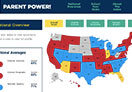
PARENT POWER! NEEDS TO GROW The 2017 Parent Power! Index (PPI) was released in September, taking the pulse of how much opportunity states afford parents when it comes to their ability to navigate and exercise power to make decisions for their kids. As we have maintained ever since we first opened in October 1993, when it comes to the education of their kids, every parent deserves robust opportunities to control the education of their youth, and access to a fully transparent system of information that allows them to be informed consumers. But the Index revealed that while the best states remain those – like Florida (89.2%), Indiana (89.1%), and Arizona (89%) continue to give parents easy access to data, lots of options and the ability to impact public policy, most do not:
Sadly, three of the states that actually have some of the largest illiteracy rates have the lowest scores: Alaska (18%), Nebraska (14%), and North Dakota (13%). The Index gives parents an interactive tool to discover whether their state affords them due power — and, if not, what they can do to get it. Similarly, the Index helps legislators and policymakers understand how their state stacks up nationally, and how to improve their ranking. Check it out at parentpowerindex.2024.edreform.com 
VOICES OF COLOR, VOICES FOR OPPORTUNITY CER has moved quickly to marshal a truth squad of voices who know firsthand that the NAACP’s “study” that “justifies” its new opposition to charter schools is a misrepresentation of reality and who want to help counter the assertion through the opinion pages of leading news organizations. Among our new voices of color are the following prestigious gentlemen in the African-American community, with more to come in the weeks ahead. School Choice Is Crucial For African-American Students’ Success USAToday T. Willard Fair, President & CEO, Urban League of Greater Miami, Inc. September 21, 2017 “The NAACP refuses to acknowledge the benefits that come from school choice and expects all people of color should follow their lead. I won’t. Here’s what I need to say to them, to the people of this nation, to people of color — I am involved in the school choice movement because the future of my life and your life depends upon it. Starting the state’s first charter school was one of the most significant accomplishments of my life. Because of our willingness to look beyond traditional divisions and leave beyond our tendency to only work with those with whom we are comfortable, our children of color are closing the achievement gap.” Supporting Black Colleges Helps Charter Schools Chicago Tribune News Service Johnny C. Taylor, Jr., President & CEO, Thurgood Marshall College Fund, September 29, 2017 “It’s become clear the organization that once supported the greatest needs of our disadvantaged is no longer interested in that work…We cannot afford this kind of issue-myopia in our society. The stakes are simply too high as fragile communities continue a downward spiral. The only solution is to improve educational outcomes and that begins with increasing school choices for parents. We have seen the dangerous domino effect if kids in these communities are forced to stay in failing schools. And while the NAACP and Weingarten seem to be perfectly comfortable with that scenario, we are not.” For more, go to 2024.edreform.com/the-latest. Each of these and other pieces will be distributed to all state and federal lawmakers throughout the country. If you are interested in helping us pay for this important distribution which has to occur on paper and through the US mail in order to reach them with impact, please contact me at 202-750-0016. 
IN AND AROUND OUR NATION’S CAPITAL CER is leading the charge in Washington to educate the still new administration and members of Congress about the importance of innovation and opportunity and how they can use their bully pulpit and numerous activities to promote both. Our Rural Education Initiative Education, Training, Workforce and Apprenticeship (ETWA) Tax Credit That has resulted in our developing the Education, Workforce and Apprenticeship Tax Credit Act concept. There is an urgent need to ensure the preparation of current and future workers for the changing U.S. economy, a focus of both the President and U.S. Congress. The ETWA tax credit would meet this need by benefiting learners at all levels. Encouraging Competency-based Higher Ed Personalized Learning & Education Innovation 
POLLS, SURVEYS AND STATISTICS In August, PDK came out with its annual look at the state of attitudes toward public education, and at the end of September came the College Board, which finally got around to releasing its national SAT data after dribbling out local findings for a month. In both cases the data were, let’s say, underwhelming. PDK poll misses the point: In August when PDK issued their 49th annual poll, we wrote that the PDK poll is “a good opportunity to take the public’s temperature” on education but “fails to reflect the reality that more than 60 percent of our nation’s students lack proficiency in core subjects.” So, we took the opportunity to address the poll’s cumbersome and confusing framework by publishing our own special report — Understanding the 49th Annual PDK Poll: The Public’s Attitudes Toward Public Schools Are Confused and Mixed — which detailed PDK’s failure to depict the realities in American education today. Our conclusion: “If education in this nation fails to provide a foundation for each child to be educated in the manner, and with the content needed to meet their greatest potential, live a productive life with civility and have the ability to handle all that life brings them, whether or not our neighbors, family or country agree with the way we each may choose to get there is really not the point.” Read the full report at https://2024.edreform.com Return of the SAT: The ever-evolving exam with new sections and aptitude measures continuously being taken away or added, makes year-to-year, apples-to-apples comparisons difficult. Most recently, the College Board added measures to gauge students’ readiness for college. It’s a noble goal, but it is still not entirely clear what it all means (although it may be telling to note that while the number of students who take the test continues to increase, the “readiness” of students for college is stuck at just 46 percent). Whether or not these scores mean something is still open to question. Why they should mean something is well known. For a refresher on the subject you can read CER’s New Opportunity Agenda on our website. Millennials speak: A survey released in September by GenForward found that millennials (individuals aged 18-34) have a surprisingly interesting take on higher education. According to the study, conducted by researchers at The University of Chicago, the majority of millennials, across ethnic boundaries, support publicly funded vouchers to supplement low income students’ tuition at private schools: 79% of African Americans, 76% of Asian-Americans, 77% of Latinos and 66% of whites are in favor of them. Charter schools also resonate with these young adults with 65% of African-Americans, 61% of Asian-Americans, 58% of Latinos and 55% of whites supporting charters. The millennials surveyed also expressed views contradicting the idea that everyone needs to attend college, with only 62% of Asian-Americans, 57% of Latinos, 55% of whites and 51% of African-Americans saying that a college degree is the key to success. 
A CONVERSATION FOR THE FUTURE AT 24 
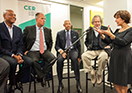
“How can we, through a variety of efforts, whether it’s through technology, innovation or policy, have an equal opportunity for everyone to participate in the future?” Those were the words of Silicon Valley entrepreneur Michael Moe, and it was the central question addressed by him and the nation’s leading education innovators and thought leaders (and they all happen to serve on CER’s Board of Directors!) on the occasion of the Center for Education Reform’s 24th anniversary on October 19. These individuals, diverse in race and ideology, are unified in their focus and their work. Their conclusion? Education must be rooted in rigor assuring high levels of literacy and numeracy, be broad in scope, personalized, and accessible beyond ZIP codes and traditional schooling lines. “The way to have better outcomes for all kids is to meet them where they are and inspire them,” said former DC City Councilman and author Kevin Chavous, rather than the current system that requires them to sit still, be directed by teachers still trained the way they were 50 years ago, and not provide them with an education that truly meets their own way and interests in learning. Former Michigan Governor John Engler kicked off the evening’s discussion, and this month he takes over as chair of the National Assessment Governing Board, which conducts national assessments and publishes “The Nation’s Report Card.” Engler’s biggest concern is with the nation’s inadequate reading scores and its multiplier effect on an individual student’s long-term growth. According to the latest assessment of reading levels, only 9 percent of 4th graders reached the level of “advanced” in reading, only 27 percent are proficient, and a combined 64 percent are basic or below basic. That’s in fourth grade. This cannot stand. Pioneers, friends and colleagues Chris Whittle and Donald Hense were equally vocal about the need to put the needs of students at the center of all we do to educate our nation’s youth. You can watch the whole event, only about an hour in length, by going to bit.ly/2gCECzE on our Facebook page and hope you will share your thoughts with us! 
Inside CER Richard Harmon, (managing director, BB&T Capital Markets) has joined CER’s Board of Directors. Mr. Harmon is a nationally recognized leader with wide-ranging experience at the intersection of finance and education. As Board Chair Jon Hage said in welcoming him to the board, 
“Richard’s leadership and 32 years of experience will contribute greatly to the bold work CER performs every day.” Richard joins our incredible – and incredibly talented and supportive – board, which in addition to Mr. Hage, includes: Michael Moe, Vice Chairman, Co-Founder, Global Silicon Valley Partners; Susan Wolford, Treasurer, Managing Director, BMO Capital Markets; Donald Hense, Secretary, Chairman, Friendship Public Charter School; Dennis Cariello, Shareholder & Ed Leader, Hogan, Marren, Babbo & Rose, Ltd.; Kevin Chavous, Author, Attorney and National Education Reform Leader; David Hardy, Founder, Boys’ Latin of Philadelphia Charter; and Chris Whittle, Founder & CEO, Whittle Schools & Studios. Also, we welcome (albeit a little belatedly) Lesley Albanese, who has joined CER as President and Chief Operating Officer. Lesley is a noted management and development professional and fills a new and critical role in the organization’s mission to advance education opportunity and innovation in America’s schools. It’s hard to believe we have actually entered our 25th year as an agent for change. Twenty-five years! That’s a long time and while I’m proud to say we’ve come a very long way, I recognize that there is still a lot to accomplish. I also recognize that without support from folks like you to sustain us, we wouldn’t have lasted 25 months, let alone 25 years. So, it is with a sincere appreciation for your friendship, gratitude for all that you have done to sustain us, and hope that we can continue to count on your support, I thank you. To celebrate 25, we will be taking our work on the road to highlight successes in innovation and opportunity throughout the country. As we develop our plan for locations, we will keep you informed. If you would like to host one of our events in your city, we are all ears. Again, just give me a call or write me any time! Have a safe and happy Thanksgiving and, if you don’t hear from us before then, a wonderful and joyous Holiday Season. With hope and commitment to the cause, Jeanne Allen, Founder & CEO 
Founded in 1993, the Center for Education Reform aims to expand educational opportunities that lead to improved economic outcomes for all Americans — particularly our youth — ensuring that conditions are ripe for innovation, freedom and flexibility throughout U.S. education. |