








Andrew Ujifusa, Education Week
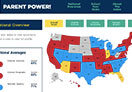
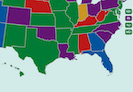
The National Alliance for Public Charter Schools has released its rankings and evaluations of state charter-school laws for 2014, and the top-10 list looks very much like the rankings the group released last year—only one jurisdiction on that list, the District of Columbia, is new (D.C. moved up from 17 to 10 this year). However, there’s been plenty of movement overall on the rankings, and well-ranked states’ raw scores improved over the last year, as you can see below.
Who were the big movers and shakers? Indiana jumped seven spots all the way up to number two, thanks to what NACPS deemed a “major piece” of legislation last year. “This legislation strengthened charter renewal processes, created statutory guidelines for relationships between charter schools and education service providers, and created statutory guidelines to govern the expansion of high-quality charter schools through multi-school charter contracts and/or multi-charter contract boards,” NAPCS states in discussing Indiana’s charter-school environment.
The “most improved” award, however, goes to Mississippi, which rocketed up 29 spots from 43 to 14 on the rankings. The Magnolia State has typically done very badly on these charter-law reports from both NAPCS and the Center for Education Reform, with both groups stating that Mississippi’s previous charter-school law all but asphyxiated them. (Both organizations are strong supporters of charter schools—I haven’t yet seen a year-over-year report card that punishes states for embracing the kinds of laws NAPCS praises.)
But under Mississippi’s new charter-school law passed in 2013, according to NAPCS, more charter schools can open, there is better funding and accountability, and the state becomes the sole authorizer of charters.
Minnesota, meanwhile, the state with the nation’s oldest charter-school law, kept its top spot in the rankings “just barely,” while Idaho and Nevada were big improvers. Decliners included Missouri, Hawaii, and Georgia, although NAPCS states that in many such cases they were simply passed by other states and didn’t make their charter laws substantively worse.
NAPCS scores state laws for charter schools based on 20 categories. States are rewarded if they don’t place caps on the number of charter schools; allow for multiple authorizers of charter schools; and allow charters the same kind of access to capital funding as traditional public schools.
“Despite significant improvements in several states in 2013, our highest-scoring state received only 75 percent of the total points,” NAPCS states in the report’s introduction, “meaning there is still much work to do to improve policies for charters, especially in the areas of operational and capital funding equity.” (Even top-ranked Minnesota only gets a 2 on a scale from 0-4 in the area of equitable capital funding access.)
“Without School Choice, Where Would I Be Today?”
At the National School Choice Week’s Whistle Stop tour event in Washington, DC on Wednesday, we had the amazing opportunity to hear first-hand how school choice directly benefitted the lives of three remarkable students in the DC area.
CER President Kara Kerwin introduced the students and listed their many accomplishments, and was joined by other distinguished speakers including Lisa Keegan, Rep. Jared Polis (D-Col.), famed political analyst Joe Trippi, and Jeanne Allen, CER’s founder and president emeritus.
A mere twenty years ago, advocating for families having the opportunity to choose between diverse and strong educational options was considered heresy. Allen and Keegan spoke of this at CER’s 20th Anniversary Conference, and reinforced it last night.
For his own part, Joe Trippi, shared his personal story of how his mother fought tooth and nail to enroll him into the neighboring and far superior public school despite not having the option, and what his educational destiny could have been simply because he lived on the wrong side of the street.
But the last aspect of the night that struck all of those in attendance was the words of Danial, a student at Friendship Public Charter School in Washington, DC. He had already completed numerous AP tests, courses for college credit, spent time at universities, and participated in extracurricular activities. His parents made the decision to send him to Friendship, a school of choice, so that he could have the educational opportunity to excel.
In concluding his remarks, Danial said, “Without school choice, who would I be today?” Had his parents not had the ability to choose a better education for him, he would have assuredly ended up at an inferior traditional public school in the Southeast quadrant of DC that is, according to him, consumed with gang violence. Simply put, his life would have been 180 degrees different without school choice.
School choice demonizes no one and helps those who are able to participate in it. It allows students to choose their own future and to have the power to achieve. The students at the Whistle Stop in DC are living proof of this.
By the time the evening came to a close, the audience left with a call to action and how far we still have left to go. Allen said that the fight for quality choice in American education “doesn’t get easier, it gets harder and gets more important every day.” Large portions of parents still do not have the power they need over their children’s education, or the greatest information available to make those important choices.
Hopefully, more students will be able to deliver testimonials as to how having power and options changed their lives for the better.