







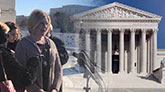


Choice IS constitutional, says the Wisconsin Supreme Court today, in a decision that is expected to draw national attention once again to the program “that made Milwaukee famous.” First instituted in 1991 for 1,000 children in non-sectarian schools it was upheld by the courts shortly thereafter.
Amicus Brief in Support of Milwaukee Parental Choice Program, Constitutionality (December 1997)
January 21, 2015 By
Weld, William
December 17, 2014 By

Bill Weld was raised in Smithtown, New York. He graduated from Harvard College in 1966 with a B.A. in classics and a year later received his diploma in economics and political science from Oxford University. He graduated from Harvard Law School in 1970. In 1974 he served as associate minority counsel to the U.S. House Judiciary Committee during its Watergate impeachment inquiry. As governor of Massachusetts from 1991 to 1997, Weld was credited with improving the business climate in Massachusetts by reducing taxes and state regulations on business. Prior to becoming governor, he served as Assistant U.S. Attorney General in charge of the Criminal Division of the United States Department of Justice in Washington, D.C., emphasizing white-collar criminal investigation and prosecution. He was the United States Attorney for Massachusetts during the Reagan administration, emphasizing public corruption prosecutions and affirmative civil litigation. He also practiced law for 13 years, concentrating in securities and antitrust litigation as a partner for two major Boston law firms.
Bill is an active member of the Council on Foreign Relations in New York and Washington, D.C., and served by appointment of the President on the U.S. Holocaust Memorial Council. Bill also serves as an associate member of the InterAction Council, a working society of former heads of state from throughout the world that convenes annually to consider and report on issues of global concern.
Walker, Wyatt T
December 17, 2014 By

Rev. Wyatt Tee Walker is internationally known for his contributions to the Civil Rights and anti-apartheid movements. A chief strategist for Dr. Martin Luther King, Jr., Walker was one of the key architects of the 1960-64 civil rights campaigns. While he was an infant, the family moved from Brockton, Massachusetts, to Merchantville, New Jersey, a town renowned at that time for rampant racism and segregation. At nine years old, Walker staged his first civil rights protest when he and his siblings refused to be turned away from a segregated movie house and instead entered the theater and took their seats. At Virginia Union University, Walker met Dr. Martin Luther King, Jr. The two built a lasting relationship, and Walker soon became King’s key strategist for the civil rights campaigns. Walker orchestrated some of the key events of the Civil Rights Movement, including student sit-ins, freedom rides, and protests and marches in Albany, Georgia; Atlanta; and Birmingham. He is most well known for his success with “Project C,” which was a strategic plan for the mass marches in Birmingham and served as a blueprint for subsequent civil rights campaigns. Walker has held numerous influential positions both in and out of the ministry. In 1967, Walker took the Chief Minister position at Harlem’s Canaan Baptist Church, a position he held for 37 years.
Walker earned a Ph.D. in African American studies with a specialization in music in 1975, and has since published 27 books on topics including human rights, the ministry and African American musical traditions.
Thompson, Tommy
December 17, 2014 By

From 1987 to 2001, Tommy Thompson served as the 42nd Governor of Wisconsin, having been elected to an unprecedented four terms. Thompson’s initiatives during his 13 years as governor of Wisconsin included his Wisconsin Works welfare reform program and school choice program, which allowed low-income Milwaukee families to send children to the private or public school of their choice at taxpayer expense. He also created the BadgerCare program, designed to provide health coverage to those families whose employers don’t provide health insurance but make too much money to qualify for Medicaid. Through the federal waiver program, Thompson helped replicate this program in several states when he was appointed Secretary of Health and Human Services by President George W. H. Bush in 2001, a position he would hold for four years.
Thompson began his career in public service in 1966 as a representative in Wisconsin’s state Assembly. Thompson has received numerous awards for his public service, including the Anti-Defamation League’s Distinguished Public Service Award. In 1997, he received Governing Magazine’s Public Official of the Year Award, and the Horatio Alger Award in 1998. Thompson has also served as chairman of the National Governors’ Association and the Midwestern Governors’ Conference. Thompson served in the Wisconsin National Guard and the Army Reserve. Currently, he is an independent senior advisor of the Deloitte Center for Health Solutions and a partner at the law firm of Akin Gump Strauss Hauer & Feld.